
NBA Betting Tips: A Data-Driven Guide for UK Punters
Data-Driven NBA Betting Intelligence for UK Punters
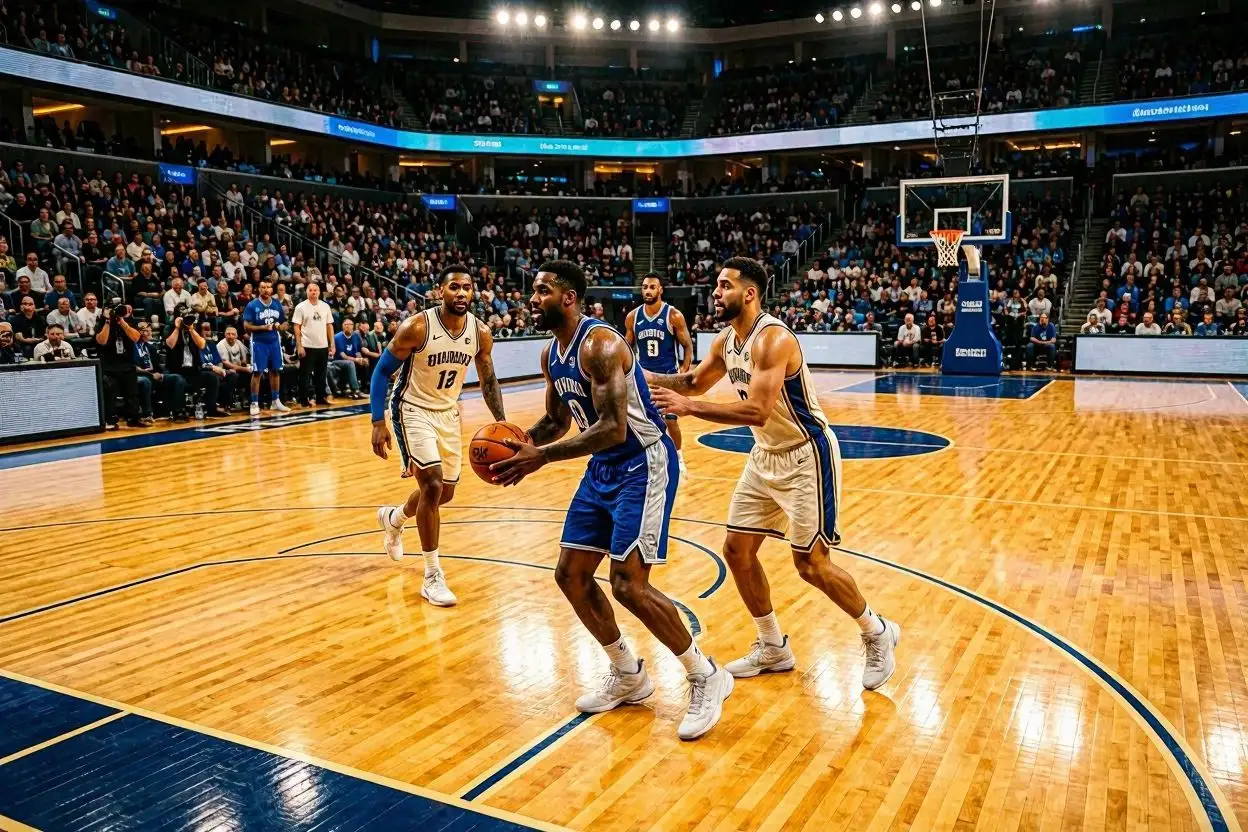
NBA Betting Tips: A Data-Driven Guide for UK Punters
What this guide covers
A complete framework for betting on NBA basketball from the UK — decimal odds, value identification, bankroll protection, advanced metrics, and situational angles — built on nine years of data-driven analysis and real market data.
Who it's for
UK punters who want to move beyond gut-feel picks and treat NBA betting as a disciplined, analytical pursuit. Whether you're placing your first spread bet or refining a system that's already profitable, every section is grounded in numbers, not noise.
Nine years ago, I placed my first NBA bet from a flat in Manchester. I backed the Golden State Warriors on the moneyline at 1.15 because they were "obviously going to win." They did win. I made about 70p. And I thought I was a genius. It took roughly six weeks and a shrinking balance to realise that picking winners and making money were two entirely different skills.
That distinction sits at the centre of everything in this guide. The global basketball betting market is now worth an estimated .7 billion, with the NBA alone driving roughly 60% of that revenue. Those numbers aren't just impressive — they tell you something about liquidity, market efficiency, and the sheer volume of sharp money flowing through NBA lines every night. Basketball accounts for 15-18% of all global wagering activity, and during the NBA season, that share swells further still. This is not a niche product. It's a market with depth, and depth rewards those who approach it with a proper framework.
The global basketball betting market reached .7 billion in 2024 and is projected to hit .4 billion by 2033 — growing at a compound annual rate of 8.7%. NBA betting alone accounts for roughly 60% of that total.
Yet most NBA betting content online reads like it was written for an American audience five years ago. American odds formats. American sportsbook promotions. American-centric strategy that ignores the specific realities UK punters face: decimal odds as the default, UKGC-licensed platforms with different market structures, tip-off times that rarely start before 23:00 GMT, and a regulatory framework that offers genuine consumer protection but comes with its own quirks. I wrote this guide to fill that gap.
What follows is not a collection of "hot picks" or a thinly-veiled promotion for a bookmaker. It's a structured methodology — the same one I use — for evaluating NBA games, identifying value, managing a bankroll, and navigating the specific challenges of betting on American basketball from this side of the Atlantic. Every claim is backed by data. Every strategy is grounded in practice. And when I don't have a definitive answer, I'll say so, because intellectual honesty is the only edge that never gets priced out of the market.
The Numbers and Principles That Shape Every Section Below
- The global basketball betting market is worth .7 billion, with the NBA driving 60% of that revenue — this is a deep, liquid market that rewards process over prediction.
- UK punters operate with structural advantages: tax-free winnings, UKGC consumer protection, and decimal odds that make implied probability calculation intuitive.
- You need a 52.4% win rate at standard 1.91 odds just to break even — every strategy in this guide is built around clearing that threshold through value identification, not gut feel.
- Situational angles like back-to-back games (1-3 point impact per academic research) and updated home court advantage (55-57%, not the outdated 60%) create measurable, exploitable edges.
- Bankroll management with flat staking at 1-2% per bet is the non-negotiable foundation — no analytical edge survives erratic stake sizing.
The NBA Betting Market in Numbers
I keep a spreadsheet of market data — updated every quarter — because the first thing any serious bettor needs to understand is the size and shape of the pond they're swimming in. The numbers tell a story that most tipster sites completely ignore, and that story has direct implications for how you find and exploit value.
The global sports betting industry grew from 9.26 billion in 2025 to 5.12 billion in 2026, with projections pushing past 5 billion by 2035 at a compound annual growth rate of 11.24%. That's the broad context. Now narrow the lens: that basketball betting market I mentioned is expected to more than double to .4 billion by 2033, and North America commands roughly 55% of the volume while the Asia Pacific region grows fastest.
Mobile platforms now handle over 70% of all basketball wagers globally. If you're not comfortable evaluating odds and placing bets from your phone, you're operating at a structural disadvantage in a market built for speed.

The American market provides useful context even for UK bettors, because US handle and revenue figures influence global line-setting. Bill Miller, President and CEO of the American Gaming Association, summarised the 2025 landscape plainly: "For another year, legal commercial gaming in the United States has delivered exceptional results for consumers, operators, and the communities we serve." US sports betting revenue hit a record .96 billion in 2025, up 22.8% year-on-year, with total handle reaching 6.94 billion. The hold rate — the percentage of wagered money operators keep — sat at 9.24% in February 2026. That hold rate matters to you directly: it represents the aggregate margin you're fighting against every time you place a bet.
The hold rate is the percentage of total wagered money that bookmakers retain as profit. A 9.24% hold rate means that for every 0 wagered across all bettors, operators keep .24 on average. Your job as a bettor is to be on the right side of that margin — which requires a win rate above the break-even threshold of 52.4% at standard odds.
Closer to home, the UK gambling industry generated GGY of .8 billion in the year to March 2025, a 7.3% increase, while the remote gambling segment — covering online NBA betting — produced .8 billion, up 13.1%. The UK market supports 914 operators, and that competition benefits disciplined bettors through tighter odds and deeper NBA coverage. But this level of liquidity also means NBA lines are reasonably efficient. You're not going to find wildly mispriced odds on a headline game. The edges are smaller, more subtle, and more situational than the "expert picks" crowd suggests — which means your energy is best spent on process, not prediction.
What UK Punters Need to Know Before Placing a Bet
When I first started sharing my NBA analysis with friends back in 2017, the most common response wasn't about strategy or stats. It was: "Why are all the odds on these American sites in that weird plus-minus format?" That single question captures the core challenge for UK punters entering the NBA betting space. The sport is American. The content is American. The odds formats, the terminology, the bookmaker landscape — all of it is built for a US audience first, and the UK gets an afterthought.
But the UK betting environment offers several structural advantages that American bettors envy. Your winnings are tax-free. UKGC licensing provides genuine consumer protection — ring-fenced funds, dispute resolution mechanisms, mandatory responsible gambling tools. The double-digit growth in remote gambling revenue I cited earlier tells you that UK operators are investing heavily in digital infrastructure, and NBA coverage has been a direct beneficiary of that investment.
Participation numbers add context: 48% of UK adults engaged in some form of gambling in the four weeks surveyed between July and October 2025, with online sports betting capturing 8-10% of the adult population. The gender split is pronounced — 15% of men versus 4% of women place sports bets. These patterns shape public money flow on NBA lines at UK bookmakers and matter when you're trying to gauge which side the casual money favours.
UKGC-licensed bookmakers must keep customer funds separate from operating capital, offer self-exclusion tools, and submit to regulatory audits. This framework means your deposited money is protected even if a bookmaker faces financial difficulty — a safeguard that doesn't exist in many other jurisdictions.

Before you evaluate a single NBA line, make sure your foundation is solid: a UKGC-licensed account, decimal odds set as your default display, and a basic understanding of how NBA tip-off times translate to UK hours. Those three fundamentals shape everything that follows.
Reading Decimal Odds and Converting Implied Probability
Decimal odds are the native language of UK bookmakers, and once you internalise the format, you'll wonder why anyone uses anything else. The number you see — 1.91, 2.40, 3.50 — tells you exactly what your total return is per pound staked. Stake at 2.40, and your total return if you win is (your back plus profit). Clean, simple, no mental gymnastics required.
Decimal odds — the total payout per unit staked, including the original stake. Odds of 2.00 mean you double your money; odds of 1.50 mean a 50% return on your stake.
The critical skill isn't reading the odds — it's converting them to implied probability. This tells you what the bookmaker thinks (or at least, what the market thinks) about each outcome's likelihood. The formula is straightforward:
Converting decimal odds to implied probability
Formula: Implied Probability = (1 / Decimal Odds) x 100
Suppose a team is priced at 1.80 to win. Implied probability = (1 / 1.80) x 100 = 55.6%.
Their opponent is priced at 2.10. Implied probability = (1 / 2.10) x 100 = 47.6%.
Combined: 55.6% + 47.6% = 103.2%. That extra 3.2% above 100% is the overround — the bookmaker's built-in margin.
To find the "true" implied probability, divide each figure by the combined total: 55.6 / 103.2 = 53.9% and 47.6 / 103.2 = 46.1%.
Understanding implied probability is essential if you want to assess value. Every time you place a bet, you're implicitly saying: "I believe this outcome is more likely than the odds suggest." If the decimal odds imply 53.9% and your analysis puts the true probability at 58% or higher, you've found a value bet. If your estimate aligns with or falls below the implied figure, the bet has no edge — no matter how confident you feel about the result. I run this conversion on every single line I consider, and I'd estimate it stops me from placing at least three bad bets per week.
Overround — the margin built into odds that ensures the bookmaker profits regardless of outcome. Also called "vig" or "juice" in American terminology. A lower overround means better value for the bettor.
Managing NBA Tip-Off Times from the UK
This is the part of NBA betting that no American guide will ever address, because it simply doesn't affect them. Most NBA games tip off between 19:00 and 22:00 Eastern Time, which translates to midnight through 03:00 GMT (or 01:00 through 04:00 BST during summer). The marquee late-night West Coast games? Those don't finish until 05:00 or 06:00 UK time.
Betting while sleep-deprived is one of the most reliable ways to destroy a bankroll. If you find yourself placing live bets at 03:00 on a Tuesday, ask whether your decision-making is genuinely sharp or whether fatigue is masking poor judgement. I've learned this the hard way more than once.
My approach, refined over several seasons, is to split NBA betting into two modes. First, pre-match analysis: I do all my research and line evaluation during UK daytime hours, typically between 17:00 and 21:00 GMT, when lines are posted and injury reports start filtering in. I place most bets before midnight. Second, selective live engagement: I stay up for a maximum of two games per week — usually high-value spots where live betting offers clear entry points — and never on consecutive nights. This discipline has improved both my results and my health, and I'd argue the two are directly connected.
Weekend NBA matinees (starting at 17:00-19:00 Eastern, which is 22:00-midnight GMT) are the most UK-friendly scheduling window. Build your weekly slate around these when possible, and treat weeknight games as pre-match-only opportunities unless a specific situational angle justifies the late night.
NBA Betting Markets Explained
A friend once told me he'd been betting on the NBA "for years" but had never placed anything other than a moneyline bet. He'd been leaving money on the table — or more precisely, he'd been ignoring entire categories of markets where his basketball knowledge could have been deployed more efficiently. The NBA offers a wider range of betting markets than almost any other sport, and understanding what each market actually measures is the first step toward matching your analysis to the right wager.
At standard odds (typically around 1.91 in decimal format, equivalent to -110 in American), you need to win 52.4% of your bets just to break even. That figure is the gravity of sports betting — it pulls everything toward the house unless you actively fight it. The three core markets below each present different pathways to clearing that threshold, and each rewards a slightly different type of analysis.
Vig (or juice) — the commission embedded in the odds. At standard 1.91/1.91 pricing, the bookmaker takes roughly 4.8% regardless of outcome. Your 52.4% break-even rate accounts for this cost.
Point Spreads: The Most Popular NBA Market
The point spread is the backbone of NBA betting. The bookmaker assigns a handicap — say, -6.5 to the favourite — and you bet on whether that team wins by more than 6.5 points (covers the spread) or the underdog keeps it closer (or wins outright). A bet on the favourite at -6.5 requires a seven-point victory or more. A bet on the underdog at +6.5 means they can lose by up to six points and you still win.
Example: NBA point spread line at a UK bookmaker
| Team | Spread | Decimal Odds | Implied Probability |
|---|---|---|---|
| Team A (Favourite) | -6.5 | 1.91 | 52.4% |
| Team B (Underdog) | +6.5 | 1.91 | 52.4% |
Spreads equalise the two sides of a bet, which means the bookmaker is expressing a view on the margin of victory rather than just the winner. This makes spread betting more nuanced than moneyline: you're not asking "who wins?" but "by how much?" That distinction opens up analytical edges around schedule context, injury impacts, and pace mismatches that moneyline bets often ignore. For a deeper exploration of spread mechanics and the strategies that exploit market inefficiencies, I've written a dedicated spread betting guide that picks up where this overview leaves off.
Moneyline Betting: Picking the Winner
Moneyline is the simplest NBA market: pick the team that wins the game, full stop. No handicap, no margin, no complications. But simplicity breeds complacency, and that's where most punters go wrong. When a team is priced at 1.12, the implied probability is 89.3%. You need them to win roughly nine times out of ten just to break even. One upset wipes out eight winners. I've watched bettors stack heavy-favourite moneylines into parlays, treating each leg as a "sure thing," and the maths consistently punishes that approach.
Moneyline betting works best at the margins: slight underdogs priced between 2.20 and 3.00, where the implied probability sits in the 33-45% range and the market tends to underestimate teams in favourable situational spots. It also works as a hedge — combining a moneyline underdog with a spread favourite from the same game can create positions with asymmetric payoffs. The key is knowing when the moneyline offers better risk-adjusted value than the spread, and that's a calculation, not a hunch.
Over/Under Totals and Pace Context
Totals betting asks a fundamentally different question from spreads or moneylines: not who wins or by how much, but how many combined points both teams score. The bookmaker sets a line — say, 224.5 — and you bet on whether the final combined score lands over or under that number.
This market is where pace analysis earns its keep. Two teams that play at a top-five pace (possessions per 48 minutes) will produce more scoring opportunities than two bottom-five pace teams, regardless of defensive quality. But pace alone isn't sufficient — you also need to assess offensive and defensive efficiency in that specific matchup, because a fast-paced game between two elite defences can still land under. I treat totals as a two-variable problem (pace multiplied by combined efficiency), and when my estimate diverges from the bookmaker's line by more than two points, I have a potential bet. For a thorough breakdown of how pace-adjusted metrics translate to totals predictions, the advanced stats for betting guide maps metrics to markets in detail.
Finding Value: Expected Value and Closing Line Value
I lost money in my first three seasons of NBA betting. Not because I was bad at picking winners — my hit rate hovered around 53-54% — but because I was systematically backing overpriced favourites and ignoring the mathematical reality of what "value" actually means. The turning point came when I stopped asking "will this team win?" and started asking "are these odds offering me a positive expected return?"
Expected Value — EV — is the single most important concept in betting. It quantifies whether a bet is worth placing, irrespective of whether that individual bet wins or loses. A positive EV bet will make you money over a large sample. A negative EV bet will drain your bankroll over time, no matter how clever you feel when you place it. Bill Miller's observation that "2025 was another strong year" for the gaming industry isn't a coincidence — operators are profitable precisely because most bettors consistently place negative EV wagers.
Calculating Expected Value on an NBA spread bet
Suppose you estimate Team A has a 57% chance of covering the spread. The bookmaker offers decimal odds of 1.91.
EV = (Probability of winning x Profit per unit) - (Probability of losing x Stake per unit)
EV = (0.57 x 0.91) - (0.43 x 1.00)
EV = 0.5187 - 0.43 = +0.0887
A positive EV of +0.089 per unit means that for every staked, you expect to profit 8.9p over time. This is a clear value bet.
Now suppose your estimate is only 53%. EV = (0.53 x 0.91) - (0.47 x 1.00) = 0.4823 - 0.47 = +0.012. Still positive, but barely — and if your probability estimate is off by even 1-2%, the bet flips to negative EV.

The practical challenge is obvious: how do you estimate probabilities accurately enough to trust an EV calculation? This is where Closing Line Value — CLV — becomes your reality check. CLV measures whether the odds you bet at were better than the odds available at tip-off (the closing line). If you consistently beat the closing line, your probability estimates are, on average, sharper than the market's final assessment. Sharp bettors treat CLV as their primary performance metric, because a bettor who beats the closing line will be profitable over any sufficiently large sample, even during rough patches.
Value-driven approach
- Calculates EV before every bet
- Only bets when estimated probability exceeds implied probability
- Tracks CLV to measure long-term accuracy
- Accepts short-term losses if the process is sound
- Adjusts stake size to reflect edge magnitude
Outcome-driven approach
- Bets on teams "likely to win" without quantifying likelihood
- Chases recent winners regardless of current odds
- Measures success by win-loss record alone
- Increases stakes after losses to "recover"
- Ignores line movement and market signals
The 52.4% break-even threshold at standard 1.91 odds means your edge doesn't need to be enormous. A bettor who wins 55% of spread bets at standard odds generates a healthy long-term profit. But that 2.6% edge above break-even is razor-thin, and without tracking CLV, you'll never know whether your wins came from genuine skill or variance. The live betting strategy guide shows how these same EV principles apply in real-time markets where value windows open and close in minutes.
Four Situational Angles That Move the Needle
Every NBA game happens inside a context that extends well beyond the two rosters on the court. Schedule density, travel distance, home crowd dynamics, and rest asymmetry all create measurable distortions in team performance — distortions that the betting market sometimes prices correctly and sometimes does not. These four situational angles form the backbone of my pre-game checklist, and over nine seasons, they've been the most consistently profitable layer of analysis I've found.
I want to emphasise a distinction that gets lost in most betting content: none of these angles work as standalone betting systems. Blindly fading every team on a back-to-back will not make you rich. The edge comes from combining situational context with line analysis — identifying spots where the market has under-weighted a factor you can quantify. With that caveat firmly in place, here are the two angles that generate the most reliable signals.
Situational angles are most valuable when they overlap. A team playing its second back-to-back in a week, on the road, against a well-rested opponent at altitude — that compound context creates a larger pricing gap than any single factor alone. I track these overlaps in a simple spreadsheet and only flag games where at least two angles converge.
Home Court Advantage: Updated Numbers
If you've read any NBA betting guide published before 2020, you've probably seen the claim that home teams win 60% of their games. I repeated that number myself in early articles, and it was already wrong by the time I wrote it. The reality in the modern NBA is a home win rate of 55-57% in the regular season, translating to an advantage of approximately 3-5 points in the spread.
Home court advantage in the NBA has declined steadily over the past two decades. The current 55-57% home win rate represents roughly a 3-5 point spread advantage — meaningful but substantially less than the 60% figure still cited by most betting sites.
That decline matters enormously for spread bettors. If you're pricing a game using an outdated 60% home win assumption, you're building a 3-5% error into every calculation involving home and away performance. Over a season of bets, that error compounds. The shrinkage is driven by several factors — improved travel logistics, reduced schedule density, and the league's deliberate effort to minimise competitive imbalances — but the practical implication for bettors is simple: home court advantage is real, it's quantifiable, and it's smaller than the market often assumes, which means road underdogs have more value than a surface-level view would suggest.
Back-to-Back Games and Rest Advantage
Back-to-back games — where a team plays on consecutive nights — are the most researched scheduling factor in NBA analytics, and for good reason. Academic research published by Wang et al. in 2024, analysing 2,295 NBA games through Frontiers in Psychology, found that rest advantage influences outcomes by 1-3 points. That's a significant spread-relevant figure, and it's backed by a dataset large enough to trust.
NBA teams averaged 14.9 back-to-back game sets in the 2024-25 season, a reduction of roughly 23% compared to a decade earlier. The league has actively minimised scheduling disadvantages, which paradoxically makes the remaining back-to-back spots more impactful for bettors — when they do occur, teams may be less conditioned to handle them.
The nuance lies in the asymmetry. A team on zero days' rest facing an opponent with two or three days' rest presents a much starker disadvantage than a team on one day's rest versus another on one day's rest. I look specifically for rest asymmetry of two or more days combined with a road trip, because that compound scenario is where the 1-3 point impact is most likely to manifest and where lines are most likely to under-adjust. The broader implications of rest, travel, and scheduling patterns are something I explore in the player props strategy guide, where fatigue affects individual stat lines even more visibly than team outcomes.
Bankroll Basics: Protecting Your Edge
I'll tell you the most expensive lesson I've learned in nine years: finding value means nothing if your staking destroys the edge before it has time to compound. In my second season, I had a genuinely profitable approach — 56% win rate on spread bets, solid CLV numbers — but I was staking erratically, sometimes 8-10% of my bankroll on a single game I felt "very good about." A seven-game losing streak in February 2019 wiped out five months of profit. The strategy was sound. The bankroll management was nonexistent.
The maths of ruin is unforgiving. At a standard 52.4% break-even rate, even a bettor with a genuine 55% edge will experience losing streaks of ten or more bets at some point during a full NBA season. If you're staking 10% per bet, ten consecutive losses reduce your bankroll by 65%. If you're staking 2% per bet, the same streak costs you 18% — painful but survivable, and your edge has plenty of room to recover.
Flat staking: a baseline approach
Starting bankroll: 0. Unit size: 2% = per bet.
After a 55% win rate across 100 bets at 1.91 odds:
Wins: 55 x .10 profit = 0.50
Losses: 45 x .00 = 0.00
Net profit: .50 (10.1% return on bankroll)
That 10.1% return over roughly three months of NBA season might not sound dramatic, but it compounds. A bettor sustaining this edge across a full season generates 30-40% annual returns — figures that professional investors would consider exceptional.

Flat staking — betting the same fixed amount on every wager — is the simplest system that actually works. It's what I recommend to anyone who has been betting for less than two seasons, because it eliminates the temptation to oversize based on confidence. The Kelly Criterion offers a more sophisticated alternative, adjusting stake size proportionally to your estimated edge, but it requires accurate probability estimates. Feed the Kelly formula a bad estimate and it will tell you to stake aggressively on a negative EV bet. I use a fractional Kelly approach — half the stake the full formula recommends — which sacrifices some theoretical upside for protection against estimation errors.
Lia Nower, Director of the Rutgers Center for Gambling Studies, described the current sports betting landscape starkly: "This is the tip of the iceberg — and the inevitable outcome when you rampantly legalize sports wagering." Her point applies to individual bettors too. Easy access to markets demands stronger self-imposed discipline, not less. Bankroll management is that discipline expressed mathematically.
The full mechanics of Kelly Criterion, unit sizing, and ROI tracking fill a guide of their own — and I've written one. The bankroll management guide walks through worked examples with real NBA scenarios, covering everything from initial bankroll sizing to when (and whether) to resize your units after a winning stretch. What matters here is the principle: no edge survives bad staking, and the most sophisticated analysis in the world is worthless if it's not paired with the discipline to stake appropriately.
NBA Betting Integrity: What the 2025 Scandal Means for You
In October 2025, federal prosecutors in the United States charged 34 individuals in a case that connected illegal sports betting operations, rigged poker games, and the transfer of insider information from within the NBA ecosystem to outside bettors. The indictment identified a minimum of seven NBA games between February 2023 and March 2024 where insider information was allegedly used to gain betting advantages. If you bet on the NBA, this affects you — not theoretically, but practically.
The 2025 indictments represent the most significant NBA integrity case in over a decade. Regardless of your betting approach, understanding how insider information can distort markets protects you from unknowingly placing bets on compromised lines.
The mechanics matter for bettors. The scheme didn't involve fixing final scores in the way most people imagine match-fixing. It centred on the transmission of non-public information — injury updates, lineup decisions, effort levels — to bettors who could act on that information before the market adjusted. This type of edge is most exploitable in player prop markets, where a single piece of insider knowledge (a player is carrying a minor injury that won't appear on the official report) can shift the value of a props line dramatically. Joyce Lian, writing in the Cornell Journal of Law and Public Policy, framed the structural issue clearly: "The NBA is responsible for maintaining the integrity of the game, while Congress should recognize that even those who make millions a year are turning to illegal betting and gambling schemes."
Player prop markets are structurally more vulnerable to insider information than game-level spreads or moneylines. A single player's performance can be influenced by undisclosed factors that don't affect the overall game outcome. This doesn't mean you should avoid props — it means you should be aware of unusual line movement on individual player markets, especially close to tip-off.
What does this mean in practice for a UK punter placing bets through a UKGC-licensed platform? Three things. First, diversify your bet types rather than concentrating exclusively on player props, where manipulation risk is highest. Second, pay attention to late line movement that can't be explained by public information — if a player's points line drops sharply thirty minutes before tip-off without a corresponding injury report, treat that as a red flag. Third, recognise that regulated markets with transparency and oversight are your best protection. The UKGC framework, whatever its imperfections, provides a layer of regulatory accountability that underground or offshore operators do not. The scandal isn't a reason to stop betting on the NBA. It's a reason to bet on it more carefully, through legitimate channels, with your eyes open.
Responsible NBA Betting: Beyond the Disclaimer
Every betting site has a responsible gambling disclaimer somewhere in the footer. Most of them read like legal boilerplate, because that's exactly what they are. I want to have a more honest conversation about what responsible betting looks like when you're actually doing it, rather than when a regulator is requiring you to talk about it.
The demographics of who bets on sports — and why — tell a revealing story. Among 18-24-year-olds in the UK, the primary motivation for gambling is enjoyment, not profit. In older age groups, financial motivation takes over. UK Gambling Commission data from 2025 found that 42% of gamblers reported positive emotions from their most recent betting experience, while 35% felt neutral. Those numbers are encouraging on the surface, but they mask the minority who experience harm — and if you're reading a 5,000-word guide on NBA betting strategy, you're more engaged than the average casual punter, which means the boundary between analytical hobby and compulsive behaviour deserves active management.
Pre-session checklist: before logging in
- Have I set a specific loss limit for this session, and will I stop when I hit it?
- Am I betting because my analysis identified value, or because I want the excitement of having action?
- Have I already placed more bets this week than my system recommends?
- Is my decision-making affected by alcohol, fatigue, or emotional distress?
- Would I be comfortable explaining this bet to someone I respect?
- Am I chasing a previous loss with this session?

That checklist lives on a sticky note next to my monitor, and I've used it to talk myself out of sessions more times than I care to admit. The most dangerous moments in NBA betting aren't the big losses — it's the slow drift from disciplined analysis into habitual action-seeking. You start the season with a clean process: research, EV calculation, measured stakes. By mid-February, you're placing bets on late-night West Coast games you haven't researched because "I've got a feel for how this team plays." That drift is how edges erode and bankrolls disappear.
Signals your process is working
- You skip games where no value exists without feeling restless
- Your bet volume is consistent week to week
- Losses don't trigger immediate "make-up" bets
- You can articulate why you placed every bet in your log
Signals drift is happening
- You're betting on every game rather than selecting spots
- Your stake sizes vary wildly based on confidence
- You feel anxious on nights when there's no NBA action
- You can't remember the reasoning behind recent bets
UKGC-licensed bookmakers offer deposit limits, session time reminders, cooling-off periods, and self-exclusion through GAMSTOP. Use them. Not as a sign of weakness, but as infrastructure. I set a weekly deposit limit at the start of each NBA season and haven't changed it mid-season in four years. That single constraint has done more for my long-term profitability than any analytical improvement, because it forces selectivity. When you can only deploy a fixed amount per week, every bet has to earn its place.
Sharpening Your Edge: Where to Go from Here
If you've read this far, you already know more about the analytical foundations of NBA betting than the vast majority of punters who rely on tips, gut feelings, and yesterday's results. But knowledge without application is just entertainment, and I'd rather you use this guide as a launchpad than a reading exercise.
Everything above — market context, value identification, situational angles, bankroll discipline — forms a framework. The sections below point you toward the deeper work that turns framework into edge.
Your immediate next step depends on where you are. If you're new to NBA betting, start with the fundamentals: learn to read spreads fluently, set up a proper bankroll with flat staking, and track every bet for at least four weeks before evaluating results. If you're already betting but not tracking, start tracking — it's the single highest-leverage change you can make. If you're tracking and your CLV numbers are consistently positive, the work shifts to optimising stake sizing and expanding into additional markets.
The five areas I'd prioritise for deeper study, in order of impact: spread betting mechanics, where most NBA volume concentrates; player props, the fastest-growing market with the widest gaps between sharp and public pricing; advanced metrics integration; bankroll management as the indispensable foundation of longevity; and live betting strategy, where real-time dynamics reward preparation and punish impulsiveness.
The NBA betting market rewards disciplined, data-literate punters who treat wagering as an analytical process rather than a prediction game. Your edge doesn't come from knowing more about basketball — it comes from knowing more about the market, pricing your own probabilities, and having the staking discipline to let your edge compound over hundreds of bets. Start with the framework in this guide, deepen it through the specialist resources linked throughout, and never stop tracking.
Frequently Asked Questions
How do NBA point spreads work and how do I bet on them?
A point spread is a handicap assigned by the bookmaker to equalise a mismatch. If Team A is listed at -7.5, they must win by 8 or more points for your bet to pay out. Back Team B at +7.5, and they can lose by up to 7 points while your bet still wins. At UK bookmakers, spread bets are typically priced at 1.91 decimal odds on each side, meaning you need a 52.4% win rate to break even. The spread is the most popular NBA market because it creates a roughly even proposition on games that would otherwise be lopsided on the moneyline.
What are the best NBA betting strategies for beginners?
Start with three foundations: learn to convert decimal odds into implied probability to identify value; use flat staking at 1-2% of your bankroll per bet; and track every bet you place for at least four weeks before evaluating results. Focus exclusively on spread bets in your first season — they're the most liquid market with the most consistent pricing. Resist betting on every game; selectivity based on situational angles like rest advantage will outperform high-volume gut-feel betting.
How do I read NBA betting odds in decimal format?
Decimal odds show your total return per unit staked, including the stake. Odds of 1.91 mean a winning bet returns .10 (.10 profit plus your stake). To find the implied probability, divide 1 by the decimal odds: 1 / 1.91 = 52.4%. If you believe the true probability is higher than what the odds imply, you have a potential value bet.
What stats should I look at before placing an NBA bet?
Prioritise team-level metrics: Net Rating (offensive minus defensive rating) is the most predictive stat for spread betting, and pace (possessions per 48 minutes) is essential for totals. For player props, focus on usage rate, minutes, and matchup-specific defensive data. Home court advantage sits at 55-57% in the regular season, worth roughly 3-5 spread points. Always check rest days and back-to-back scheduling, which research shows affects outcomes by 1-3 points.
Is live betting on the NBA profitable?
Live betting can be profitable but demands a different skill set. In-play algorithms occasionally misprice situations where context matters more than the current score — a team down 10 after a fluky run might offer value if their underlying metrics are strong. The challenge for UK punters is timing: most games run between midnight and 04:00 GMT, making fatigue a genuine factor in decision quality. Approach live betting selectively, engaging only when a pre-identified scenario occurs.
How does bankroll management work for NBA betting?
Define a fixed bankroll and stake a consistent percentage on each bet. Most professionals recommend 1-3% per wager using flat staking. At 2% stakes and a 55% win rate at 1.91 odds, a 0 bankroll generates roughly profit over 100 bets. Even a 10-bet losing streak only costs 18% at 2% staking, leaving ample room for recovery. More advanced approaches like Kelly Criterion adjust stake size by estimated edge but require accurate probability estimates.
What are NBA player props and how do I find value?
Player props are bets on individual statistical outcomes — points, rebounds, assists, three-pointers. The bookmaker sets a line, and you bet over or under. Value comes from matchup analysis: a player averaging 22 points facing a bottom-five defence at his position might truly expect 26-27, making the over attractive. Props are the fastest-growing NBA market and arguably where research effort produces the highest return — though they're also more vulnerable to manipulation, as the 2025 integrity scandal demonstrated.