
NBA Injury Impact on Betting Lines: Reading Late Scratches Before the Market Catches Up
 Available in US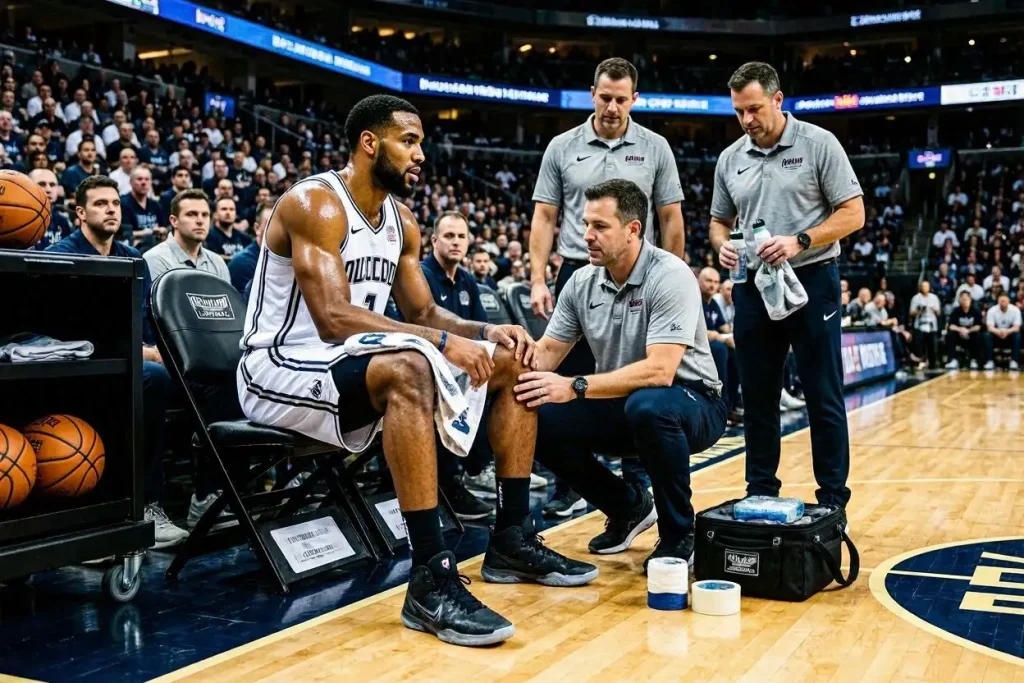
Contents
A Single Injury Report Can Move an NBA Line by Five Points
In February 2026, I had a spread bet queued up on a Western Conference matchup. The line was -3.5 for the home side. Twenty minutes before tip-off, the home team’s All-Star guard was ruled out with a knee issue. By the time I refreshed the page, the line had swung to +1.5. A 5-point shift in under half an hour — that’s how much a single player can move an NBA market.
Injuries are the single largest source of sharp line movement in the NBA. Unlike scheduling data or matchup metrics, which are available well in advance, injury information arrives on an unpredictable timeline. The NBA’s official injury report drops at 1:30 PM Eastern on game days — that’s 6:30 PM in the UK — but late scratches and game-time decisions can emerge minutes before tip-off. The bettors who access and process this information fastest have a structural advantage over everyone else.
This isn’t a theoretical edge. It’s a measurable one. The speed at which you react to injury news directly correlates with the value you can capture. A line that moves from -3.5 to +1.5 doesn’t stop at every integer along the way — it jumps in chunks as bookmakers reprice. If you’re betting on the visitor before the line fully adjusts, you’re capturing points of value that disappear within minutes.
How Bookmakers Adjust Spreads, Totals and Props After Injury News
Not all injuries move lines equally, and understanding the hierarchy of impact is essential for exploiting the adjustment window.
Star-calibre players — the top 15-20 players in the league — move spreads by 3-5 points when they’re ruled out. These are players whose absence fundamentally changes a team’s offensive system, defensive anchoring, or both. Bookmakers have pre-calculated “off” lines for most of these players, allowing them to adjust quickly. But “quickly” still means 5-15 minutes, and that window is where value lives.
Role players and rotation pieces move lines by 0.5-1.5 points. A starting centre being ruled out matters, but the spread adjustment is smaller because the replacement player absorbs some of the production. Where role-player injuries create disproportionate value is in prop markets. If a starting point guard is out, the backup point guard’s assists prop might not adjust fast enough to reflect a 30-40% increase in usage. Similarly, if a team’s primary three-point shooter is sidelined, the remaining shooters’ three-point props may be underpriced for the increased volume they’ll receive.
Totals react to injuries differently from spreads. When a high-scoring player is ruled out, bookmakers drop the total by 2-4 points. But this adjustment often overshoots. The replacement player scores less efficiently, but they still score. The team’s system generates shots regardless of who’s on the floor. I’ve found that totals adjustments after star injuries tend to be 1-2 points too aggressive — the market removes too many points from the total, creating over value in games where a key player sits. Home court advantage, already worth roughly 3-5 points in spread terms, doesn’t disappear because of one absence.
Load Management as Predictable Absence: Anticipating Rest Games
Here’s where injury analysis crosses into scheduling analysis, and where patient bettors gain a genuine edge: load management is, by definition, predictable absence.
NBA teams rest their stars on a semi-regular pattern. Back-to-back games are the primary trigger — teams in the 2026-25 season averaged 14.9 back-to-backs, and star players sat out the second game of B2B sets at increasingly high rates. But the pattern extends beyond B2Bs. Veteran stars often rest during the middle game of three-in-four-night stretches, particularly in December and January when the regular season grind peaks.
If you can anticipate which games a star will sit, you can bet the adjusted line before the market knows. I track each team’s load management history from previous seasons, noting which players are most likely to rest and under what scheduling conditions. When the current schedule produces a known rest trigger — a B2B in a West Coast city, the second game of a stretch, or a game between two national TV appearances — I look at the pre-announcement line and compare it to where I expect the line to land once the rest decision becomes official.
This approach works best with teams that have established, transparent load management practices. Some franchises announce rest decisions the day before the game. Others wait until the injury report deadline. The earlier you can identify the likelihood of a rest game, the more value you capture from the subsequent line movement.
The UK Timing Challenge: Getting Injury News Before Lines Lock
For UK punters, the timing of NBA injury information presents a specific challenge. The official NBA injury report publishes at 6:30 PM UK time — workable for most schedules. But late scratches and game-time decisions for evening tip-offs happen between 11:00 PM and 3:00 AM UK time, when most UK bettors are either asleep or not actively monitoring their accounts.
I’ve addressed this in three ways. First, I front-load my injury research during UK evening hours, between 6:30 and 8:00 PM, when the official reports are fresh and I can assess the full injury landscape for the night’s slate. Any bets I want to place based on known injuries go in during this window, before lines sharpen further.
Second, for games I’m especially interested in, I set alerts through the NBA’s official app and through team-specific beat reporters on social media. These alerts fire the moment a late scratch is announced, giving me a 5-10 minute window to act before the market fully adjusts. Whether I’m awake for that window is another matter — but on nights when I’ve identified a high-value injury scenario in advance, I’ll stay up for the specific game.
Third, and most practically, I accept that I can’t capture every injury edge as a UK-based bettor. The timing disadvantage is real. US-based bettors who are awake and active at 7:00 PM Eastern have a structural speed advantage on late scratches. Rather than fighting that disadvantage, I focus on the injury edges I can capture — the ones embedded in the official report hours before tip-off — and live betting opportunities that arise once games are underway.
Speed and Preparation Define the Injury Edge
The injury edge in NBA betting isn’t about knowing basketball medicine or predicting who gets hurt. It’s about processing publicly available information faster than the market, anticipating predictable absences before they’re announced, and understanding how each type of absence reshapes spreads, totals, and props differently. The punters who build systems for this — alerts, tracking sheets, pre-calculated adjustments — capture value that passive bettors never see.
