
NBA Line Movement Analysis: What Odds Shifts Tell You About Sharp Action
 Available in US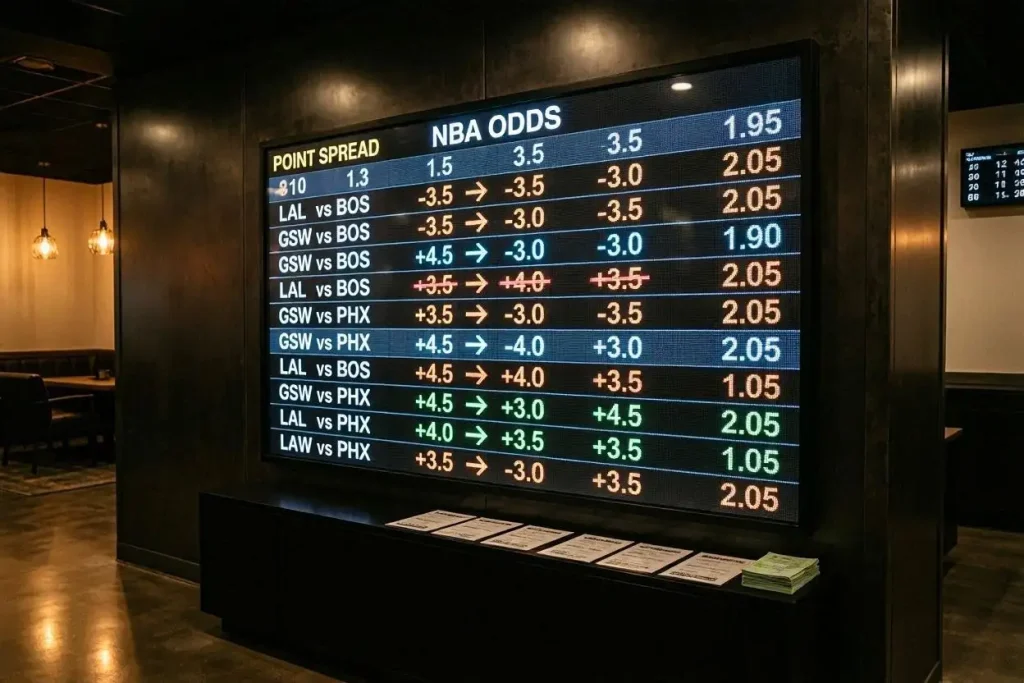
Contents
Every NBA Line Tells a Story Between Open and Close
An NBA point spread does not sit still. From the moment the opening line is posted — often 18 to 24 hours before tip-off for regular season games, longer for high-profile matchups — it begins absorbing information. Sharp accounts test it early. Recreational money piles on closer to game time. Injury reports filter through. By the time the referee tosses the ball at centre court, the closing line represents the market’s sharpest consensus on the game.
The journey between open and close is where edge lives. If you can read what a line movement means — whether it reflects sharp money, public volume, new information or simply noise — you gain a structural advantage over bettors who only look at the number itself. Most of my profitable NBA seasons have come not from predicting game outcomes more accurately than the market, but from placing bets at moments when the line mispriced the situation by half a point or a full point. Over hundreds of wagers, those fractions compound.
For UK punters using bookmakers who derive their NBA lines from wholesale US markets, understanding line movement is doubly valuable. Your bookmaker may adjust more slowly than the originating market, creating brief windows where the line you see is already stale.
From Opening Line to Closing Line: What Drives NBA Odds Movement
The opening line is set by a small number of market-making sportsbooks in the United States. These books post early, accept sharp action, and adjust accordingly. Their lines propagate to the broader market — including UK bookmakers — within minutes. The opening number reflects the market-maker’s model output plus anticipated public interest, which is why favourites in nationally televised games often open a half-point or full point thicker than the model alone would suggest.
From open to close, three forces compete. Sharp money arrives first, typically within the first few hours after posting. These bets come from professional accounts that have identified a discrepancy between the posted line and their own model. If the Suns open at -4.5 and two sharp groups independently bet the other side, the line will move to -4 quickly. The book respects this action because these accounts have a demonstrated long-term edge.
Recreational money builds throughout the day, especially as tip-off approaches. This volume tends to favour public-facing teams and recent narratives — winning streaks, star performances, social media buzz. In the February 2026 reporting period, the US sports betting hold rate sat at 9.24% on $12.66 billion in handle, a figure partly sustained by recreational bettors who chase narratives rather than value.
Information shocks — injury reports, rest announcements, lineup confirmations — create sudden, often large movements. A star player downgraded from questionable to out can shift a spread by three to five points in minutes. These movements are informational, not opinion-driven, and they reset the market rather than indicating sharp disagreement with the opening line.
The skill lies in distinguishing between these three drivers. A line that moves from -6 to -5.5 on quiet news is likely sharp-driven. A line that moves from -6 to -7 on the day of a nationally televised game with a trending star is likely public-driven. A line that moves from -6 to -3 ninety minutes before tip-off almost certainly reflects an injury announcement.
Identifying Steam Moves and Coordinated Sharp Action
A steam move is a rapid, simultaneous line shift across multiple sportsbooks, triggered when several sharp accounts hit the same side within a narrow time window. In the NBA, steam moves typically last between three and ten minutes before the market stabilises at a new number. They are the clearest signal that organised sharp money has identified a mispricing.
Recognising a steam move in real time requires monitoring odds across multiple platforms simultaneously. When you see a spread that was -4.5 at three different books suddenly become -3.5 at all three within five minutes, that is a steam move. The direction of the move tells you which side the sharps favoured. The speed tells you the market-makers agreed the original number was wrong.
Acting on steam moves from the UK is challenging. By the time you notice the shift and log into your bookmaker’s platform, the line has usually already adjusted. The practical value for UK punters is not in chasing steam but in understanding what it means after the fact. If a line steamed from -4.5 to -3.5 and then drifted back to -4 on public money, you know the sharp consensus sits closer to -3.5. Betting the current -4 in that scenario is betting against the sharpest opinion in the market.
Dead market drift is the opposite of steam. Lines that move slowly, by a quarter-point over several hours with no identifiable trigger, typically reflect balanced recreational flow or bookmaker margin adjustments. These moves carry minimal informational value. I generally ignore movements of less than half a point that occur gradually unless they contradict the direction of public betting percentages.
Using Closing Line Value to Measure Your Own Betting Skill
Closing line value is the single most important metric for evaluating your own betting performance. The concept is straightforward: did you get a better price than the closing line? If you bet the Pacers at +3.5 and the line closed at +2.5, you captured a full point of CLV. If you bet them at +3.5 and the line closed at +4.5, you paid more than the market ultimately decided the game was worth.
Why does CLV matter more than win rate? Because the closing line is the sharpest, most efficient price the market produces. It incorporates all available information and all sharp opinion. Consistently beating the closing line means you are identifying value before the broader market does — and that skill is predictive of long-term profit in a way that short-term win rate is not. A bettor who wins 55% of their wagers but consistently gets worse prices than the close is likely running hot. A bettor who wins 51% but consistently beats the close by half a point has a genuine, sustainable edge.
To break even at standard -110 vig, you need that 52.4% hit rate. CLV helps you determine whether you are actually operating above that threshold by skill rather than variance. Over a sample of 500 or more NBA bets, your CLV average is a far more reliable indicator of ability than your raw record.
Tracking CLV requires recording three data points for every bet: the price you took, the time you placed it and the closing price. Many UK bookmakers do not display closing lines after tip-off, so you may need to reference a US odds-tracking site to capture the close. It adds a few minutes to your post-game review process, but the diagnostic value is significant.
One pattern I have observed over nine seasons: bettors who focus on beating the close naturally gravitate toward earlier bets, better line-shopping habits and sharper game selection. CLV is not just a measurement tool — it reshapes the behaviours that produce long-term profitability.
