
NBA Public Betting Percentages: When to Fade the Crowd and When to Follow Sharp Money
 Available in US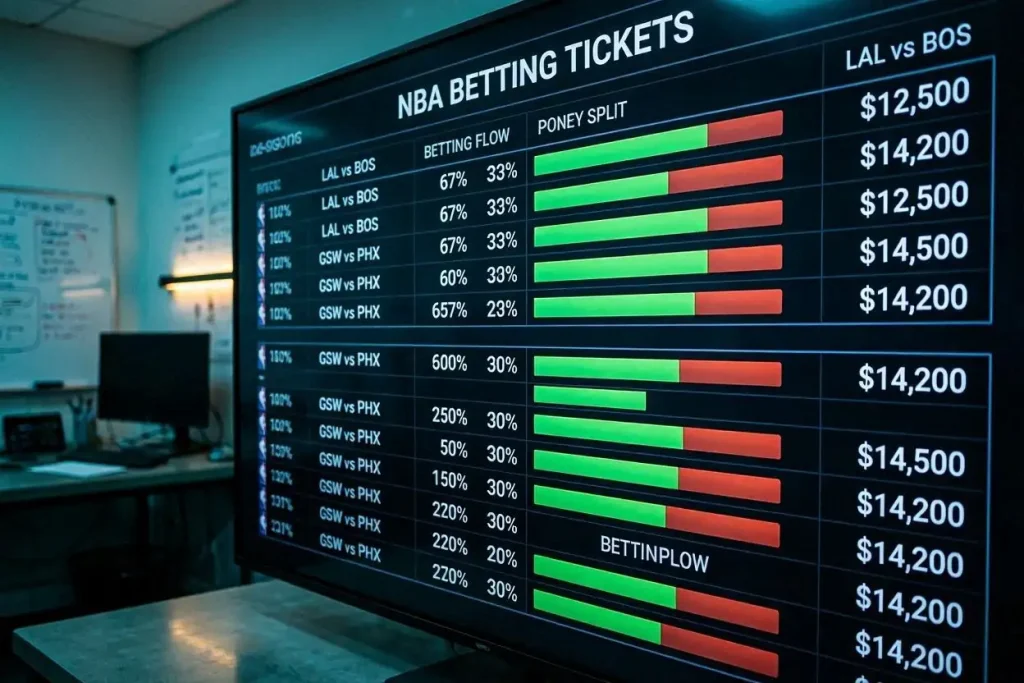
Contents
The Public Loses at a Predictable Rate — Here’s How to Measure It
There is an old line in betting circles that the public exists to fund the bookmaker’s margins. That is not entirely fair, but the underlying maths holds up. At standard vig on a point spread, a bettor needs to win at least 52.4% of wagers just to break even. Most recreational bettors fall well short of that threshold over a full NBA season, and the collective weight of their action creates patterns you can observe, measure and sometimes exploit.
Public betting percentages represent the share of total tickets or total money wagered on each side of a given line. When 78% of tickets land on the Lakers to cover a spread and the line stays flat or moves the other way, something interesting is happening. That divergence between where the crowd is betting and where the line is moving often reveals the presence of sharp money on the opposite side — and that information is worth more than any tip sheet.
For UK punters, this concept requires a small mental adjustment. The American sportsbook model, where books actively balance action and shade lines toward public sides, operates differently from the margin-based model most UK bookmakers use. But the underlying signal — large public consensus on one side, contradicted by line movement — still holds value because UK bookmakers reference the same wholesale odds markets influenced by sharp action in the United States.
How to Interpret Public Money Splits and Ticket Counts
Public betting data comes in two flavours: ticket percentage and money percentage. They sound similar but tell different stories. Ticket percentage counts the number of individual bets placed on each side, treating a 10-pound wager and a 10,000-pound wager identically. Money percentage weights by stake size, so a single large bet from a sharp account can swing the money split dramatically even when the ticket count barely moves.
The signal you are hunting is the gap between these two numbers. When 72% of tickets are on Team A but only 55% of the money sits there, the implication is clear: the majority of bettors are backing Team A with modest stakes while a smaller number of larger accounts — typically sharps — are loading up on Team B. That imbalance is worth paying attention to.
Timing matters as well. Early in the week, lines for marquee NBA games may attract recreational interest from fans who bet on name recognition and recent form. As tip-off approaches, sharper accounts step in and the money percentage often shifts. Monitoring these changes between the opening line and the line at game time gives you a dynamic picture rather than a static snapshot.
One caveat: free consensus data from aggregator sites can be unreliable. These platforms sample from one or two sportsbooks and extrapolate. The data is directionally useful but not precise. Treat public percentages as one input in your model, not the sole basis for a wager. If you combine public betting splits with line movement analysis, the picture sharpens considerably.
Reverse Line Movement: When Sharp Money Overrides the Public
Reverse line movement is the single most reliable indicator that sharp money is active on a game. The concept is simple: the line moves in the opposite direction to where the majority of public tickets are landing. If 70% of bets are on the Celtics at -5.5 and the line moves to -5 or even -4.5, that means the book is responding to significant money on the other side — money large enough to outweigh the risk of all those public tickets.
This happens because bookmakers are not purely balancing action. They shade lines toward the public side to increase their margin, and when a line moves against that shade, the sharp pressure must be substantial. In the NBA, where daily volume is high and lines are relatively efficient, reverse line movement stands out precisely because the market is otherwise well-arbitraged.
Identifying reverse line movement requires you to track both the opening line and the current line alongside ticket percentages. If the Bucks opened at -3.5 and are now -2.5 despite drawing 68% of public tickets, that is a textbook reverse move. The question is whether to act on it. In my experience, reverse line movement on NBA spreads between one and four points — the range where games are genuinely competitive — is a stronger signal than on blowout-range spreads where line adjustments are less meaningful.
Not every reverse move is sharp-driven. Injury news, late lineup changes and load management announcements can all move a line against public sentiment for purely informational reasons. Before labelling a move as sharp action, check whether any material news has dropped since the line opened. If the news landscape is quiet and the line is moving against the crowd, you have a genuine contrarian signal.
A Contrarian Framework for NBA Betting: When Fading Works and When It Doesn’t
Fading the public is not a strategy in itself. It is a filter. Blindly betting against the majority on every NBA game would produce results close to the break-even line minus vig — which is to say, a slow loss. The edge comes from applying contrarian thinking selectively, in situations where public bias is most pronounced and least justified.
The strongest fading opportunities tend to cluster around a few patterns. Marquee teams with national television exposure attract disproportionate public money, especially when they are playing at home against less glamorous opponents. The public overweights recent narratives — a team on a five-game winning streak draws far more tickets than their underlying metrics justify, while a solid team coming off two losses against elite opponents gets undervalued.
Context matters more than the raw percentage. A 75% public lean toward a legitimately dominant team is not the same as a 75% lean toward a mediocre team riding a hot streak. FanDuel and DraftKings together control roughly 75% of the regulated US handle, and the recreational volume flowing through these platforms creates systematic biases around brand-name franchises that appear on major broadcast schedules.
Where fading fails is in playoff series after Game 1. The public often overreacts to a single playoff result, but the market corrects quickly because sharp interest in playoff games is substantially higher than in regular season. By Game 3 or Game 4 of a series, the public and sharp sides often converge, and contrarian signals lose their edge. I focus my contrarian approach almost entirely on the regular season and the first round of the playoffs, where recreational volume is highest relative to sharp volume.
The discipline required is unglamorous. You are betting on teams you may not like, in games that lack excitement, against the consensus of friends and commentators. That discomfort is precisely why the edge exists — if fading the public felt natural, everyone would do it and the market would adjust.
