
Responsible NBA Betting Guide: Pre-Commitment Strategies, Session Limits and Self-Exclusion
 Available in US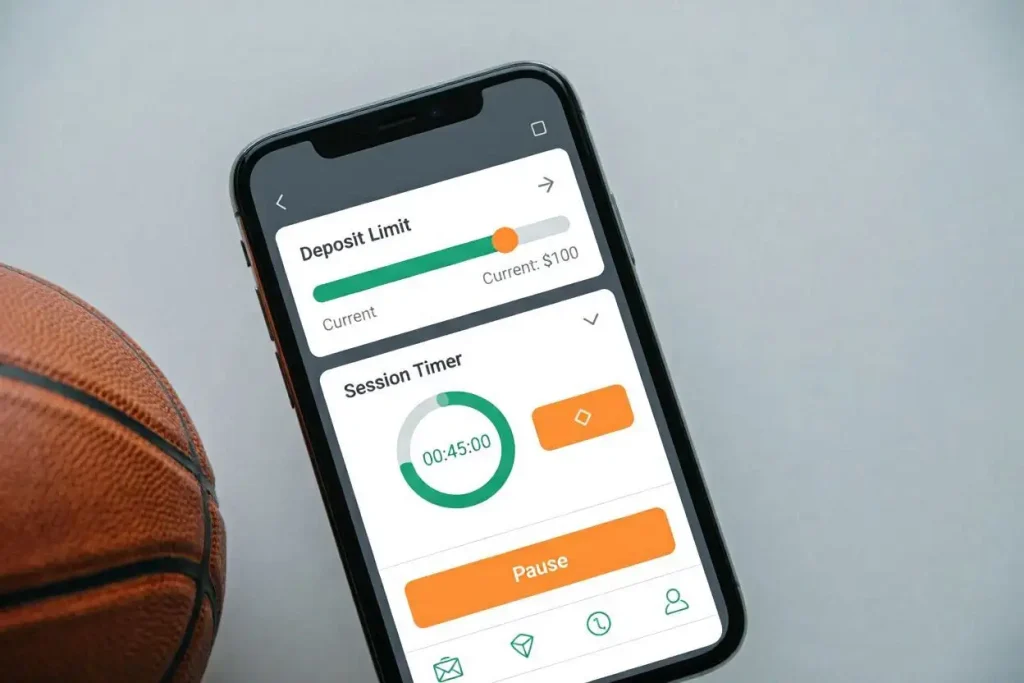
Contents
Responsible Betting Isn’t a Disclaimer — It’s a Strategy That Protects Your Edge
Every betting site carries a responsible gambling disclaimer. Most punters scroll past it. That is understandable — the disclaimers are often boilerplate, designed to satisfy regulatory requirements rather than genuinely help you manage your activity. But responsible betting as a practice, separated from the corporate language surrounding it, is one of the most powerful tools in a serious NBA bettor’s framework.
The connection between responsible betting and profitability is direct. An NBA bettor who chases losses, extends sessions beyond their planned duration and increases stakes after bad runs is not just making emotional decisions — they are systematically eroding whatever analytical edge they might possess. Pre-commitment tools, session limits and loss limits are not moral lectures. They are structural safeguards that prevent the psychological pitfalls of betting from undermining sound process.
Around 48% of UK adults participate in some form of gambling over any given four-week period. Within that large population, the range of engagement runs from annual lottery tickets to daily sports wagering. Where you sit on that spectrum matters less than whether you have intentional boundaries around your activity. This guide treats responsible betting as strategy, not sermon.
Pre-Commitment Tools: Setting Limits Before You Start
Pre-commitment means making decisions about your betting activity before the emotional pressures of a live session take hold. It is the gambling equivalent of meal planning — you decide what you are going to do when your judgement is clear, and then you follow the plan when temptation arrives.
The most effective pre-commitment tool is a deposit limit. Every UKGC-licensed bookmaker is required to offer daily, weekly and monthly deposit limits that you set yourself. Once a limit is reached, you cannot add more funds until the next period begins. Setting this limit before the NBA season starts — based on your total bankroll and your planned staking approach — removes the possibility of impulsive top-ups after a losing night.
Among younger UK bettors aged 18-24, research indicates that entertainment value is the primary motivation for gambling, outweighing financial gain. That motivation is legitimate, but it also creates a risk: when betting is framed as entertainment, the cost of that entertainment can escalate without the bettor noticing. A deposit limit converts an open-ended entertainment expense into a fixed budget, no different from setting a monthly cap on dining out or streaming subscriptions.
Time-based pre-commitment is equally important for NBA betting specifically. Games tip off late in the UK — often between 23:00 and 03:00. Deciding in advance that you will watch and bet on two games maximum, regardless of what happens in those games, prevents the drift into extended late-night sessions where fatigue degrades decision quality. I set a hard stop for myself at 01:30 on weeknights, which means I focus on the early tip-offs and accept that some value in later games will go unexploited.
UK gambling survey data shows that 42% of participants reported positive emotions from their most recent gambling experience while 35% reported neutral feelings. That leaves a meaningful minority whose experience was negative — and pre-commitment tools exist largely to prevent neutral or positive experiences from gradually shifting into harmful patterns through escalating stakes and extended sessions.
Session Limits and Loss Limits: Practical Implementation
A session limit defines how long you will bet in a single sitting. A loss limit defines the maximum amount you are willing to lose before walking away. Both are essential for NBA betting, where the combination of late-night scheduling and multiple simultaneous games creates an environment designed to extend your engagement.
For session limits, the practical implementation depends on your typical NBA betting pattern. If you bet pre-match only, your session is defined by the time you spend researching and placing bets — typically 30 to 60 minutes. If you bet live, your session extends to the duration of the games you are watching. Setting a firm endpoint prevents the common pattern of thinking “I’ll just stay for one more quarter” when that quarter turns into another game, then another.
Loss limits should be expressed in units rather than pounds. If your unit size is 10 pounds and your session loss limit is five units, you stop betting after losing 50 pounds in a single session regardless of how many games remain. This approach scales automatically with your bankroll and maintains consistency across different staking levels. Some bettors use a two-unit-per-game loss limit instead of a session limit, which caps exposure on any single event while allowing continued activity on subsequent games if the limit is not triggered.
The psychological challenge is not setting limits but honouring them. After three consecutive losses, the urge to increase stakes and recover is powerful. Pre-commitment works because the decision was made before that emotional state arose. If you find yourself regularly overriding your own limits, that pattern itself is a signal worth taking seriously — not as a moral failing, but as an indication that your bankroll management approach needs structural reinforcement.
GAMSTOP and Self-Exclusion: How the UK System Works
GAMSTOP is the UK’s free, centralised self-exclusion service. When you register, all UKGC-licensed online gambling operators are required to block you from opening new accounts and using existing ones for a period you choose: six months, one year or five years. The service covers online operators only — it does not extend to betting shops, which have their own multi-operator self-exclusion scheme.
Self-exclusion is the most significant responsible gambling tool available, and it exists for situations where deposit limits and session management are insufficient. Around 8-10% of UK adults participate in online sports betting, and while the majority do so without developing problematic patterns, the availability of a comprehensive exclusion mechanism provides a safety net for those who need it.
Registration is straightforward: you provide identification details on the GAMSTOP website, choose your exclusion period and confirm. The exclusion takes effect within 24 hours across all participating operators. During the exclusion period, you should also receive no marketing communications from those operators. At the end of your chosen period, the exclusion does not automatically lift — you must actively choose to return, which builds in an additional decision point.
For NBA bettors who recognise that their engagement has shifted from analytical and enjoyable to compulsive or financially damaging, GAMSTOP provides a clean break. The fact that it covers all UKGC-licensed operators simultaneously is critical — partial exclusion, where you block yourself from one bookmaker but open an account at another, does not address the underlying pattern. The comprehensiveness of the system is its strength.
Beyond GAMSTOP, individual bookmakers offer their own cooling-off periods — typically 24 hours, 48 hours or one week — for punters who want a temporary pause without full exclusion. These shorter breaks can be useful during high-volume NBA periods, such as the first round of the playoffs, when the temptation to overbet is highest.
